
How much does a fibreglass pool cost in New Zealand?
A pool is really two spends: the pool, and what you put around it. Here’s roughly what people pay for both.
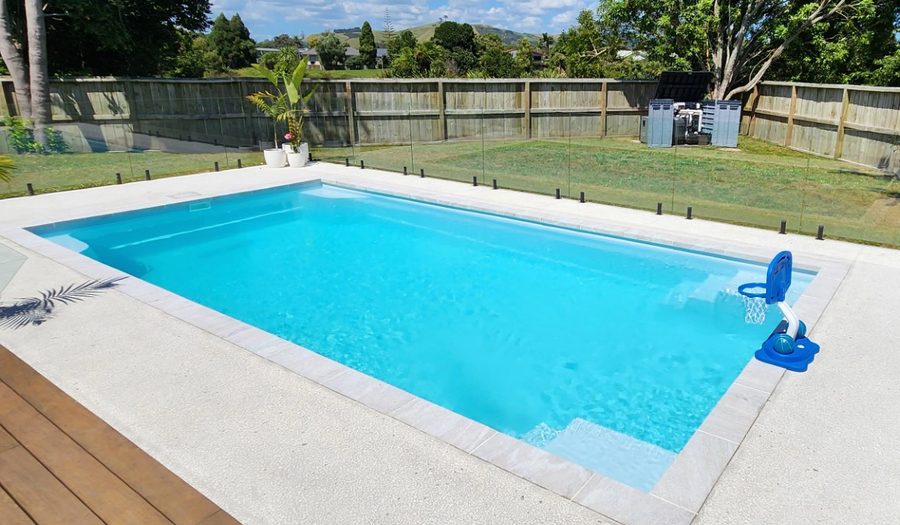
Every pool gets priced on the section it’s going into, so no two quotes ever come out the same. What follows is the rough shape of it: what the pool costs on its own, what the surrounds add, and what nudges the number up or down. Have a read, then talk it through with your local installer. Nothing here is a quote. Their written quote is the price, and the one that counts.
What a fibreglass pool costs in New Zealand
There are two numbers because you’re really buying two things. The pool side of it splits at 35,000 litres, which is where the trade splits it too. Under that, you’ve got the smaller pools, up to the 7 m Cove. Over it, the 8 m Satin through to Big Bertha at 12 m, which is a fair bit of pool.
These are guide prices, GST included. A rough idea of the money, not a quote. What you get for it: the pool in the ground and running. What you don’t: the crane, the consent, the electrical, water where it has to be trucked in, anything above the ground, and any equipment upgrade. The table takes it line by line. Your installer writes the real price. These figures are just the context for it.
| What you are buying | Our guide, incl GST | What you get, and what you don’t |
|---|---|---|
| Installed in the ground — under 35,000 litres, up to the 7 m Cove Tranquil 3.6 m, Pause 4 m, Element 5.45 m, Plunge 5.5 m, Retreat 6.5 m, Cove 7 m |
$32,000 – $60,000 the pool on its own, in the ground and running |
What you get: the shell, delivery from Whakatāne, standard excavation and site prep, backfill, the pump and filter, the concrete ring beam, water to fill, commission. What you don’t: everything above and around the pool. Fencing, copings, the concrete surround, paving, decking, landscaping, and any equipment upgrade. |
| Installed in the ground — over 35,000 litres, 8 m to 12 m Satin 8 m, Shoreline 9 m, Coastline 10 m, Big Bertha 12 m |
$60,000 – $80,500 the pool on its own, 8 m to 12 m |
What you get: the shell, delivery from Whakatāne, standard excavation and site prep, backfill, the pump and filter, the concrete ring beam, water to fill, and commission. Bigger pool, so more digging and backfill, more water, and more concrete in the ring beam. What you don’t: fencing, copings, the concrete surround, paving, decking, landscaping, and any equipment upgrade. Same boundary line, whatever the size. |
| What goes around the pool landscaping, copings, paving, decking, retaining: on top of the pool price, not inside it. Its own spend, usually done later |
$15,000 – $25,000 a standard surrounding $30,000 – $60,000 the high end, and it can go further |
The concrete surround or the paving, a deck, copings, retaining, planting, and the fence. None of it is in the pool price. A straightforward surround sits at the bottom of this. A section finished in stone or timber, with the levels worked out, sits at the top. It’s the bit of the budget people underestimate most. It’s also where one question saves you a phone call later: some of our installers do the landscaping around the pool, and some don’t. Ask yours. |
| The difference between us and an imported shell same size pool, same inclusions, someone else’s quote |
$10,000 – $20,000 more what buyers tell us |
Same shell, different price. A shell moulded in Whakatāne is built the same way as one moulded in Australia: same layers, same laminating specification. The extra money is freight, storage and the businesses in between, not better material. A bigger price tag isn’t proof of a better pool. |
Both prices sit in the middle of their size. Not the cheapest you’ll be quoted, and not the dearest. Size is what moves you up or down inside each one: we mould ten models, from the 3.6 metre Tranquil up to Big Bertha at 12 metres, and a twelve metre pool is a very different job from a three and a half metre one. Most of the pools we sell go in on their own. The surrounds get done later, and who does them is your call: us, or another contractor you’d rather use. Either is a perfectly good answer.
What sits outside the pool price
None of this is in the price above, and none of it is hiding inside it either. Each one is its own line on your quote, and each one you’re free to say no to:
- Copings. Concrete or real stone. Priced per pool rather than per square metre, and they come first in the build. They’re the line where the pool starts looking like a pool.
- A heat pump. Stretches the season out. It’s a line on your quote like anything else, and you’ll know the price before you decide.
- In-floor cleaning. The self-cleaning option, and the one with real figures behind it. More under equipment and heating.
- Lights, covers and a premium sanitiser. Each a quoted option, and each a line you can cross off.
- The crane, and what the ground does. Usually a hiab, from about $800, and lifting the shell in over the house is all in a day’s work for one. Now and then a section needs something a lot bigger, and that can run to about $7,000. More under what moves the number.
- The fence and the consent. A compliant barrier is the law. Not the fun part of the budget, but not optional either. Your installer sorts the consent and will tell you who’s doing the fence.
Tell us what you want around the pool and we’ll price it into the same quote, so the whole job sits on one page. If you’d rather keep it simple for now, that’s fine as well: we’ll send the pool price on its own and add the rest when you’ve had a think.
Why ours costs less
Our shells cost us less, and the difference is in how many hands they pass through. Not in the shell.
A quote for the same size pool, with the same things in it, usually comes in $10,000 to $20,000 above ours. The shell is rarely the reason. It’s how many businesses get paid between the mould and your backyard. Ours is a short line: we mould it, and the installer you meet sets it. That’s the whole trick, really.
Same standard, wherever the mould sits. A shell moulded in Whakatāne is built the same way as one moulded in Australia: same materials, same hand-laid layers, same laminating specification, and we’ll put yours in writing. The extra money isn’t a better shell. It’s the overseas leg and everyone it passes through: freight, a container, storage, an importer, a brand owner, each paid out of the one sale. Made here, that list is a lot shorter, and we pass the saving on. None of it makes anyone else’s pool worse.
And if a bigger price tag would make you feel better about it, just say so. We’re more than happy to charge you more. Same shell, same warranty, and one very impressive-looking invoice.
What’s in the price, and what isn’t
The short version: if it’s the pool itself and it’s in the ground, it’s in. If it’s around the pool or on top of it, it gets its own line. Nothing sits hidden in the middle. Here’s the whole thing, both halves:
In our standard install price
- The fibreglass shell
- Standard excavation and site preparation
- Backfill and preparation of the hole
- Filtration, pump, tri-chlor feeder, starter tablets
- Cleaning equipment
- The standard concrete ring beam
- Delivery from the Whakatāne factory
- Water to fill, where it doesn’t have to be trucked in
- Commissioning — filled, filtration running
Not in it, and never hidden in it
- Pool fencing, glass or aluminium — mandatory, and its own line on the quote. Ask your installer who does the fencing where you are
- Copings, paving, the concrete surround
- Landscaping, decking, planting, retaining, lawn
- Crane hire, where a truck and machine cannot reach
- Electrical work for the pump house and heat pump
- Building consent, backflow preventer, resource consent
- Water to fill, where it is trucked in
- Removing fill from site, and moving fill on site
- Every upgrade: heat pump, self-cleaning, lights, covers, sanitiser
If a number turns up with no breakdown at all, that’s the thing to ask about. Not the price. We’d much rather you asked us than wondered.
What actually moves the number
Five things separate the bottom of the range from the top. The shell isn’t one of them, which is good news for everybody.
- Size. A plunge pool and a big family pool are different jobs: more to dig, more backfill, more water, more coping, a heavier shell to lift. It’s the biggest lever there is. The pool on its own runs from about $32,500 at 4 metres to $75,000 – $79,000 at 12 metres.
- Access and the ground. If a truck and a digger can get from the road to where the pool’s going, the job’s straightforward. If they can’t, the work changes and the price follows it. Difficult access is common, it’s solvable, and your installer prices it rather than discovering it halfway through. Rock, a high water table and unstable ground all land in the excavation line. That’s why we ask for your address and photos of the driveway, the gate and the route through the section. A site visit settles it.
- What goes around the pool. Copings, paving, the concrete surround, decking, landscaping and retaining. Usually a later purchase, and it’s the line people leave out of the budget most often.
- Equipment. Basic filtration and a pump come with the pool. A heat pump, self-cleaning, lighting, covers and a premium sanitiser are choices, each priced on its own line, and each one you can say no to.
- Where you are. Not a regional price list. It’s how the shell travels and who does the earthworks. Route restrictions or vehicle size limits can force a longer route, some cities only allow oversize loads in set hours (which can mean a pilot vehicle), and South Island deliveries carry the ferry cost. Even with the ferry on it, it still comes in a long way under bringing the same shell in from Australia, and we’d rather the money stayed here than paid for a container across the Tasman. Think of the ferry as the one leg of the trip with a view.
The crane, and what the ground does
The pool turns up on a truck and goes in on a crane, so the lift is its own line on the quote. Most of the time it’s a hiab, from about $800, and going over the house is no trouble for one at all: a lot of our jobs run 25 or 30 metres from the road, and the shell goes in over the roof on the way. Every so often a property needs something a lot bigger, though, and that’s a different day: a road closure, a lift with no way in from the road, a section that’s tight in every direction. On one of those the line can run to about $7,000. Both figures are ours, not a crane company’s quote, because the lift gets priced on the day by the installer arranging it. The ground works the same way. A standard dig, the base and the backfill are in the price. Rock, a high water table, dewatering, retaining, and carting fill away are not. They land in the excavation line once the ground’s open, which is why your quote names them as estimates up front. Nobody enjoys a surprise on the last page of an invoice. Least of all us.
Fencing, consent and the works around the pool
Some of it we do, some of it other people do. All of it belongs in your budget from day one.
The fence is compulsory. A compliant pool barrier is a legal requirement in New Zealand, and putting one in generally needs a building consent. Your installer walks you through the consent at design stage and tells you who’s doing the fence where you are. We don’t publish fence prices, because we don’t set them and they move with the region and the product. One thing worth knowing before you ring anyone: frameless glass usually costs two to three times what an aluminium fence does. Same barrier, a lot more labour and hardware in it. It does look lovely. Mind you, at that price it ought to.
Consent depends on the size of the pool. Under 35,000 litres the pool is exempt work under Schedule 1 of the Building Act. Over it, building consent applies and the work gets inspected, and from 8 metres the consent covers the pool and its fencing, which we manage for you. Ask and we’ll put the compliance paperwork for your own shell in your hands.
Copings, paving, decking, retaining and planting are a mixed bag, so ask. Some of our installers do the landscaping around the pool themselves. Some don’t, and they’ll point you at a local trade they trust. So before you ring anyone: ask your local installer whether landscaping around the pool is something they do. Full landscaping packages are available in some service areas and not others, so it does depend on where you are.
Landscaping is usually its own spend, and often a later one: the pool goes in first, and the surrounds happen afterwards. Whoever does it prices it, whether that’s us or a contractor you already use, and the rate is theirs to set. What we can give you is a feel for the money, and the things that move it: what the landscaping costs, and what changes it.
What the landscaping costs
It’s the number people get wrong, and it’s worth ten minutes now. It saves an argument later.
A pool needs something between the shell and the rest of the section: concrete, paving, decking, copings, retaining, planting. A standard surrounding usually comes in between about $15,000 and $25,000. At the high end, with stone or timber and the section properly worked out, that’s $30,000 to $60,000, and it can keep going from there, depending on what you want around your pool. Not one bit of that is in the pool price. It’s extra, and it’s usually spent later, once the pool’s in. It’s a guide for your budget, not a quote. The scope moves it, never the pool on its own.
| Your options around the pool | What it is | Where it sits on cost |
|---|---|---|
| Poured concrete surround Poured in place, rolled finish, half black |
The shape follows the shell and the section. Our own line includes 1.5 cubic metres of hardfill and expansion joints cut in after the pour. It doesn’t include the excavation. | The lowest of the usual options — typically about a third under a deck. |
| Hardwood deck Vitex, screwed down with stainless steel |
Chosen where the ground slopes, where the surround has to meet your floor level inside the house, or where you’d rather not retain and fill. Timber is also a surface you look after. | The most expensive of the usual options — decking carries far more labour per square metre, because every board is laid and fixed by hand. |
| Copings Concrete or real stone |
The strip along the top of the shell, covering the fibreglass edge. Measured for the pool itself, not for the area around it. | Priced per pool, not per square metre — so they don’t get cheaper by paving less. They come first in the build order too. |
| Concrete with stone tiles over it | The top end of the usual hardscape: the surround poured, then tiled in stone along the walkway and the sitting area. | Past $100,000 of landscaping on a big pool done this way. That’s our guidance, and the scope and the section are what decide it. |
What changes the number
- The size of the pool. A 12 m pool has far more edge to finish than a 4 m one. The bigger the pool, the more surround there is to pay for.
- Decking the whole way around. It costs more than a poured surround, and the more of the perimeter you deck, the wider that gap gets.
- Tiles on top of concrete. Pouring the surround and then tiling it in stone is the move that takes landscaping out of a budget and into one of its own.
- Levels, fill and retaining. A sloping section is the usual reason a deck gets chosen at all, and the usual reason a retaining line turns up on the quote.
- Access, and when the work gets done. A machine that can’t reach the back of the section changes the job and the price, and it’s cheaper and easier while the excavation is open and the digger’s already on site.
Concrete around a pool isn’t concrete on a driveway
This is the one people push back on, so here’s why it lands where it does. A pool surround is a fiddlier job than ordinary flatwork. The shape follows the shell, the fall has to run away from the pool, the finish has to live with pool water and pool chemicals, and not many concrete crews will take the work on at all. The ones who do charge more for it than for the same area of driveway. Sorry about that. The shape, the access, the levels, the finish and whether there’s already a machine on site move it more than any single figure could, and the number belongs to the contractor quoting your section.
So there’s no rate sheet here, and that’s on purpose. Concrete, paving, decking, copings and fencing get priced on your site by the people doing the work. Put a rate per square metre on a page and our installers would be stuck defending a number they never wrote, for a section they’ve never seen. So we give you the figures and the things that move them, and leave the quoting to the trade. Shorter conversation for everyone.
A starting point for your budget, and nothing more. Not a quote, and not a rate we set for anyone else.
More on how the surrounds and the section work together: our landscaping guide.
The shell is the thing to check
It’s the one part of the pool you can check before you buy anything. Not the price, and not the brochure.
Plenty of shells sold here come out of a mould somewhere else, and that’s fair enough. What matters is who moulded it, what it’s built from, and whether the maker will put it in writing. Here’s ours, so you can hold it up against any answer you get.
- Moulded here, by hand, in layers. ToughShell Tech is our name for how that shell is built: moulded in Whakatāne, by hand, in layers.
- Six layers, each with a job to do. The gelcoat you swim against. A resin-rich corrosion barrier right behind it, “the layer standing between your shell and osmotic blistering”. The structural glass laminate that carries the water and the ground. A 4 mm Coremat core with ribs laminated in behind the walls and through the top flange. Glass laminated over that core, so it’s encapsulated and tied back into the structure rather than sitting in the wall. And a flow coat sealing the outside face against ground moisture.
- No single thickness, deliberately. Wall laminates run about 7–9 mm, and the corners and steps 12–15 mm, because that’s where the loads concentrate. A 12 metre shell is laminated heavier than a 3.6 metre one.
- One moulded piece. No panels, and no joints in the water line.
- The finish is a named system, not just a colour. Ours is ChlorShield, which is “designed to resist the toughest pool chemicals without fading, chalking, or surface breakdown”.
- Recorded shell by shell. Every stage is inspected and signed off on that shell’s own quality control sheet, and the batch numbers, amounts used and thickness sprayed at each layer are recorded as it’s built. Ask, and we’ll put your pool’s lay-up details in writing.
- Installed by the business that quoted it. Ten licensed local installers, each running their own building or excavation business. The person who quotes your pool is the person standing on your site when it goes in.
Five questions worth putting to any quote
Put them to every quote you get, ours included. A company that can answer all five is selling you a pool. One that can’t is selling you an invoice.
- What’s in the price, line by line, including what’s been declined? Ours are itemised, and each thing the client said no to stays on the quote as a $0 line, so the boundary is visible.
- Who moulded the shell, and where? Every Bayside shell is moulded in our own Whakatāne factory rather than imported complete, and you’re welcome to come and watch one being made.
- What’s the shell built from, and what’s its laminating specification? Ours is six layers, hand laid, and we’ll put your own shell’s specification in writing if you ask.
- Who installs it, the team that quoted or a subcontractor? On our installs the shell is set by the same team that quoted the job.
- Who honours the warranty, locally, and for how long? 20 years on the structure, 15 on the finish, in writing, and it moves once to the next owner.
A higher price can be money well spent. More pool, a harder site, more work around it, more equipment. What it can’t buy on its own is a better shell, a longer warranty or a better installer. So if you’re holding a quote for the same size pool, with the same things in it, that comes in well above ours, send it over. We’ll go through it with you line by line, whether it ends up being ours or not. No hard feelings either way.
Equipment and heating
Basic pump and filter come with the pool. Everything else is a choice, priced per option on your quote, so you can see what each one costs before you say yes to it.
On keeping it clean, in-floor is the refreshingly blunt option. It means “you stop vacuuming”, with up to 30% fewer chemicals and 20–30% lower heating costs, because the water keeps moving instead of sitting on the surface. It won’t take the rest of the job off you, either: “an in floor cleaning system removes the floor-cleaning chore. It does not remove pool ownership.”
What it costs to run
Running costs follow the equipment you choose, not the shell.
Heating, chemicals, water and servicing. The in-floor figures above are the only running numbers we’ll stand behind, and they come from keeping the water moving rather than letting it sit on the surface. What we won’t do is invent an annual power bill, because it depends on your equipment, your climate and how you use the pool.
We’d rather say nothing than guess at a running cost.
From signing to swimming, and how you pay
In order: a site visit and quote, with access and ground assessed by the installer who’ll do the work. Consent, with a compliant barrier designed in. Excavation and base. The shell craned in and backfilled. Plumbing, filtration and electrical. Ring beam, copings and surround. Fill and commission. Handover and warranty registration. How long it takes depends on your site. Excavation, the base, drainage and what you’re doing around the pool afterwards all move it, and your installer will give you the schedule for yours.
Payment follows the milestones, not a calendar: a holding deposit when you accept, a second payment before your pool is manufactured, a third once it’s made and before it’s installed, and the balance when it’s finished, filled, filtration running, and you’re happy with it. The amounts are all on your quote.
What can’t be known until the ground’s open is itemised on the quote rather than discovered later: consent, the digout, removing or relocating fill, crane hire, lawn reinstatement and the electrical work.
What comes with it once you sign
Every Bayside shell goes out with a 20-year structural warranty and a 15-year warranty on the finish, both in writing. Both transfer once to the next owner, on written notice within a month of the sale. It comes with the pool.
Fibreglass, concrete or vinyl, side by side
What you’re buying, how long it takes to build, who controls the quality, and roughly where the money lands.
| Fibreglass — moulded in a factory | Fibreglass — laminated on site | Concrete — built on site | Vinyl-lined | |
|---|---|---|---|---|
| How it’s made | Moulded in a factory in Whakatāne, delivered whole and craned in | The same material, laminated on your section over a shell formed in place. The pool is made where it will sit | Built in the ground and cured on site over weeks | Panel or block shell with a liner fitted on site |
| Typical cost, same size pool | Our guide prices: $32,000 – $60,000 up to 7 m and $60,000 – $80,500 over it, the pool on its own, incl GST | Comparable to a moulded shell. The same material and the same job, with the laminating done on your section instead of in a mould. That’s our guidance, not a quote from anyone who builds this way | Typically about 30% above the same size moulded pool, so on our smaller figure about $41,600 – $78,000. Our guidance, applied to our own prices | Typically about 30% below the same size moulded pool, so on our smaller figure about $22,400 – $42,000. Our guidance, applied to our own prices |
| Shape | Ten moulds, so a bespoke shape isn’t on the table | Not limited to a mould: the shape is formed where the pool goes | Any shape, which is its one clear advantage | Flexible, but limited by the liner |
| On-site time | The shell is set and backfilled quickly once access is settled | Longer than a moulded shell, because the shell itself is built on your section | Longest of the four | Shorter than concrete, longer than a moulded shell |
| Who controls the quality | Laminated in a factory, where the temperature and the dust are controlled, and every stage is signed off on that shell’s own quality control sheet | The laminating happens on a building site. Getting the environment right for a spray or a hand lay-up is far harder out in the open, and that’s the trade-off for the shape | Cured on site, so the weather is part of the process | The shell is built on site and the liner is manufactured to fit it |
The concrete and vinyl figures above are our guidance applied to our own prices. Those pools get priced by the people who build them, and we’re not going to pretend we know their numbers better than they do.
Where we install, and why your region changes the number
We manufacture in Whakatāne and install nationwide through ten licensed local installers: Kerikeri and Northland, Auckland, South Auckland, Waikato, Bay of Plenty, Whakatāne, Gisborne, Hawke’s Bay, Wellington and Christchurch. Each one runs their own building or excavation business, so the person who quotes your pool is the person standing on your site when it goes in. They’re a good first call for anything about your section, including what goes around the pool.
That’s also why the price is a range rather than a number. Freight from Whakatāne, route and oversize-load limits, the ferry for the South Island and the local earthworks rates all sit inside it. Find your local installer →
Fibreglass pool cost — FAQs
How much does it cost to install a fibreglass pool in New Zealand?
Two answers, because you’re buying two things. Under 35,000 litres, the small pools up to the 7 m Cove, the pool on its own usually lands between $32,000 and $60,000 incl GST, with a 4 m at about $32,500. Over 35,000 litres, the 8 m Satin up to the 12 m Big Bertha, it’s $60,000 to $80,500, with a 12 m at $75,000 – $79,000. What goes around the pool is a separate spend: a standard surrounding usually comes in at $15,000 to $25,000, and $30,000 to $60,000 at the high end, and it sits on top of the pool price rather than inside it. None of those numbers include anything above the ground. Copings, a heat pump, in-floor cleaning, fencing, consent and the crane are each their own line. These are guide figures from experience, not a quote. Your installer prices your section, your access and your ground, and their written quote is the price. Have a read, get a feel for it, and then ask them what it looks like on your own place.
What does the pool cost on its own, without the landscaping?
The two prices above: $32,000 – $60,000 under 35,000 litres and $60,000 – $80,500 over it. Both are the pool and nothing else: the shell, the standard dig and site prep, delivery, the pump and filter, the ring beam, water to fill, and commissioning. Size is the biggest lever, with the pool on its own running from about $32,500 at 4 metres to $75,000 – $79,000 at 12 metres. Fencing, copings, the surround and landscaping are separate purchases. Most people do them later, with us or with their own tradesperson, and either is a perfectly good answer.
How much should I budget for the paving or the decking around the pool?
A standard surrounding, meaning paving, a poured surround, copings and the usual deck, usually comes in between about $15,000 and $25,000. At the top end, stone or timber with the whole section worked out, $30,000 to $60,000 and it can run further. The relationships between the options are the useful part. A poured concrete surround is typically about a third cheaper than a deck, because decking carries a lot more labour per square metre. Run stone tiles over concrete on a big pool and the landscaping can pass $100,000. Frameless glass fencing is usually two to three times the price of an aluminium fence. Copings are priced per pool rather than per square metre, and they come first in the build. All of it sits on top of the pool price. We don’t publish a rate per square metre for any of it, because those rates belong to the trade doing the work on your section. Ask your local installer whether they do the landscaping too. Some of them do, some don’t, and the ones who do can price it on the same quote as the pool.
What is included in the price?
The shell. Standard excavation and preparation of the hole. Backfill and ground preparation. The filtration system and pump, with a tri-chlor feeder and starter tablets. Cleaning equipment. The standard concrete ring beam. Delivery from Whakatāne. Water to fill. And the pool commissioned, filled with water with the filtration running.
What is not included?
Fencing, copings, the concrete surround, paving and decking, landscaping and lawn reinstatement. Crane hire where it’s needed. Electrical work for the pump house and heat pump. Building consent and any resource consent. Water to fill, where it has to be trucked in. Removal of fill from site. And every equipment upgrade: heat pump, in-floor cleaning, lighting, covers, a premium sanitiser. On our quotes these show up as itemised lines, including a $0 line for anything you declined, so you can see the boundary.
Why do some quotes for the same size pool come in higher?
A higher price isn’t evidence of a better pool. It can be a bigger pool, a harder site, more work around it, or more equipment on it. Often it’s a longer line of people between the mould and your backyard, and that’s usually where the $10,000 to $20,000 sits. Ours is a short line. What a higher price can’t buy on its own is a better shell, a longer warranty or a better installer.
Why do some pool ads look so much cheaper?
Almost always because the number is a shell, or a shell with a basic equipment package, rather than a finished pool. What those numbers leave out is the same short list every time: excavation, access, the concrete or paving surround, fencing, consent, electrical, water, and the landscaping you’ll want once the pool’s in. Add it up and the number usually lands back in the range on this page. That’s not a reason to distrust a cheap quote. It’s a reason to ask what’s in it.
Are all New Zealand-made pools built the same?
No, and “made in New Zealand” isn’t the test. It tells you where the business is, not how the shell was built. A shell can be moulded overseas and still be sold by a New Zealand pool company. What matters is who moulded it, what it’s built from, and whether the manufacturer will put it in writing. Ours is written down: moulded by hand in Whakatāne in six layers, with wall laminates about 7–9 mm and 12–15 mm through the corners and steps. Ask us and we’ll put your own shell’s laminating specification in writing.
Which is cheaper, fibreglass or concrete?
Concrete is the expensive end and vinyl is the cheapest. A concrete pool typically runs about 30% above the same size moulded fibreglass pool, and a vinyl-lined pool about 30% below it. On our guide prices that’s roughly $41,600 – $78,000 for concrete and $22,400 – $42,000 for vinyl. That’s our guidance applied to our own numbers, not a figure from a concrete or vinyl builder: those pools are priced by the people who build them. A fibreglass pool laminated on site lands in a similar place to ours. What we can put side by side is what you’re buying. A fibreglass shell is moulded in one piece in a factory and arrives made, while a concrete pool is built and cured on site over weeks. Concrete’s clear advantage is shape: any shape, where we mould ten models.
What is the downside of a fibreglass pool?
You’re choosing from existing moulds, so a completely bespoke shape isn’t available. We mould ten models from 3.6 m to 12 m. The shell also arrives made, so access matters more than with a pool built on site: a shell that can’t be brought in from the road changes the job and the cost. In exchange you get a much faster install once the shell’s on site.
How long does a fibreglass pool last?
The shell carries a 20-year structural warranty against leaks caused by defects in the shell itself, and a 15-year finish warranty against osmotic blistering. It transfers once to the next owner, on written notice within a month.
Do I need a fence and a building consent?
Both, and neither is in the pool price. A compliant barrier is required by law in New Zealand, and fitting one generally needs a building consent. Your installer walks you through what your council requires at design stage, and will tell you who’s doing the fence where you are. We don’t put a number on a fence: it differs by region and by product.
How long does it take — and can the price change once digging starts?
Time depends on your site, not on us, and your installer will give you the schedule for yours. A few lines are honestly an estimate until the ground’s open, and we name them on the quote rather than let you find out later. Consent, the digout, removing or relocating fill, crane hire, lawn reinstatement, and the electrical work.
What does it cost to run?
Heating, chemicals, water and servicing, and they follow the equipment you choose rather than the shell. For in-floor cleaning it’s up to 30% fewer chemicals and 20–30% less heat loss, because the water keeps circulating instead of sitting on the surface. An annual power bill would be a guess, and we’d rather not guess. It depends on your equipment, your climate and how you use the pool.
Can I have it cleaned for me — is there an easy-clean option?
Yes, and it’s an equipment choice rather than a promise about the surface. In-floor cleaning is the one with figures behind it: up to 30% fewer chemicals, 20–30% less heat loss, and no vacuuming. “The pool that cleans its own floor, so you stop vacuuming.” The same page is honest about the limit: “an in floor cleaning system removes the floor-cleaning chore. It does not remove pool ownership.”
We will put a quote together and send it out to you
Give us your address and a photo of the access, and we will come back to you with a quote broken down line by line — pool, install, site works and the surrounds — so you can see where every dollar sits instead of one lump sum. A photo of the driveway, the gate and the route through the section is plenty. The dog is optional. You’re buying a shell moulded by hand in Whakatāne, set by the local installer who quoted it. While you’re at it, ask your installer whether they do the landscaping around the pool. Some of ours do, some don’t, and it’s easier when it all sits on one quote. Already holding a quote for the same size pool that is higher than ours? Send it over, and we’ll go through it with you line by line, whether it ends up being ours or not. No obligation, and no rush. Prefer to look first? Browse the pool range, see the colours, or design your pool.