
Looking After a Fibreglass Pool
Ten minutes a week, one test a month, and no plaster curing in your water.
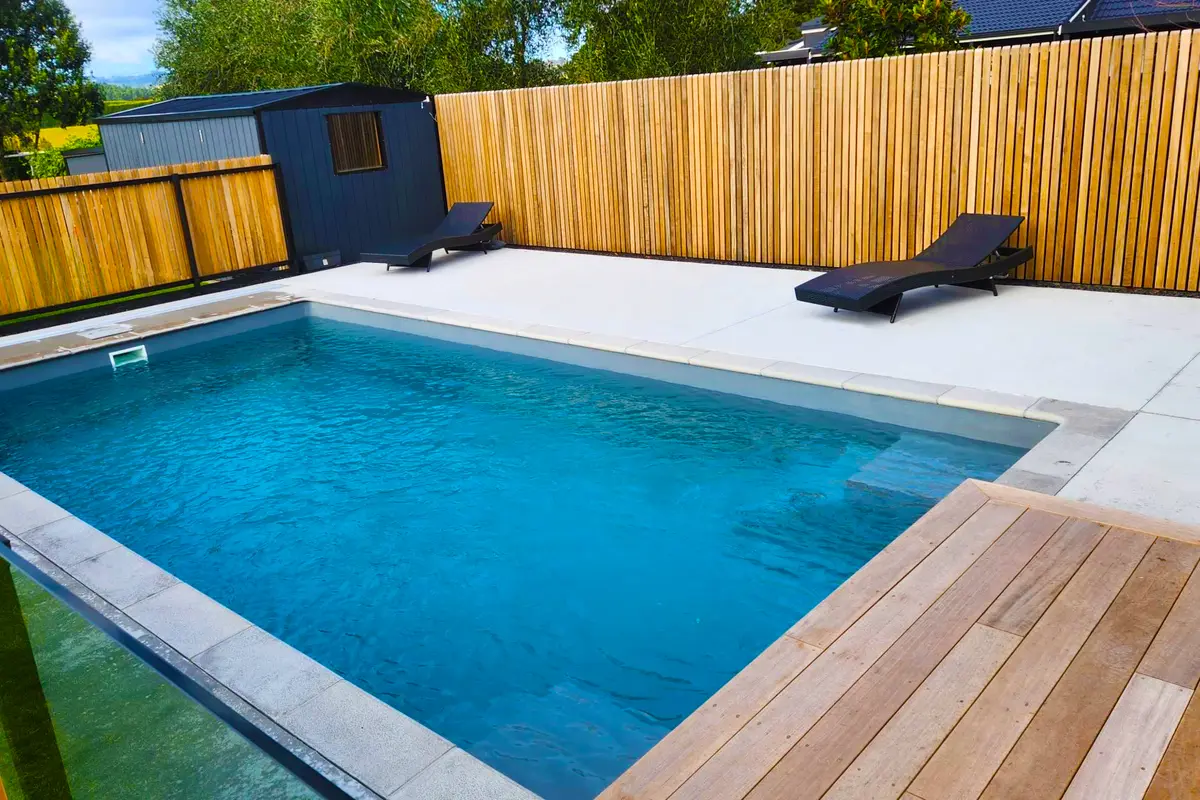
A fibreglass pool is the easiest pool there is to own, and most of that is the shell. It is moulded in one piece with a ChlorShield gelcoat on the swimming side — no grout lines to scrub, no liner to replace, and no plaster slowly curing into the water. What is left is a short weekly loop, a test kit and five numbers. We go through all of it with you at handover, on your own pool, before we leave.
The week your pool needs
Four jobs, done in one pass. Fibreglass pool maintenance is a short list, not a hobby — do this much and the pool very rarely gives you trouble.
Skim the surface
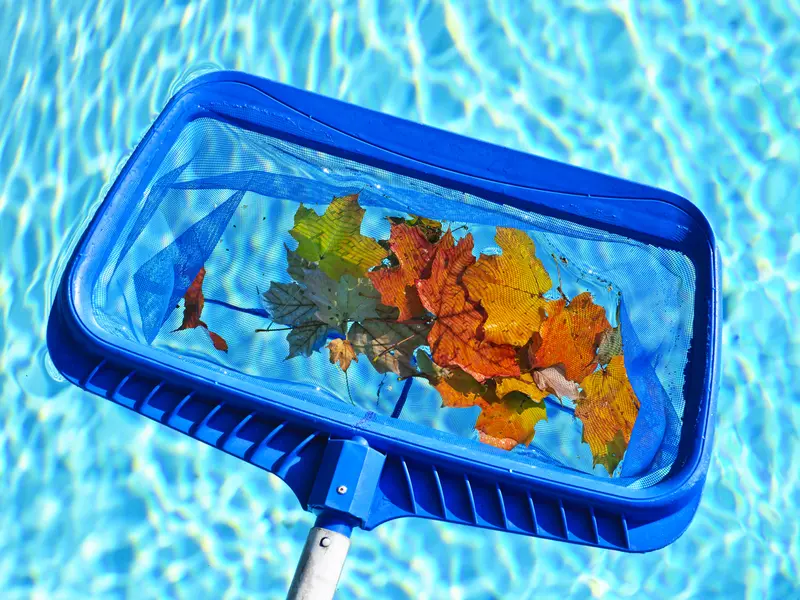
Leaves, insects and grass clippings are the fast route to cloudy water. A few minutes with a net keeps the load off the filter.
Empty both baskets
The skimmer basket and the pump basket. A clogged basket starves the pump, and the flow drops away while the pump is still running.
Brush the walls and floor
Once a week with a soft nylon brush. It lifts the film that settles on the steps, in the corners and along the waterline — the low-flow places where algae starts. Soft nylon only, never anything abrasive on a gelcoat.
Test the water
Once a month through winter, twice a month in summer, and again after heavy rain or a big swim. Almost every problem you can see was in the numbers a week earlier.
Five numbers, the same in every pool we build
Every Bayside pool is handed over on the same five readings. Keep the water inside them and the finish is being looked after the way it was meant to be.
pH
7.2 – 7.67.4 is the ideal. Chlorine works best in this band; above 7.6 it takes about four times as long to do the same job.
Total alkalinity
80 – 120 ppmThe floor the pH stands on. Hold it here and the pH stays where you put it between tests.
Calcium hardness
150 – 200 ppmKeep it at the low end. High calcium alongside high pH is the usual cause of a dull or scaled gelcoat.
Free chlorine
1 – 3 ppmThe handover range for a Bayside pool.
Chlorine stabiliser
30 – 50 ppmProtects the chlorine from the sun, so you are not buying it twice.
Salt is the one that depends on your system. A freshwater purifier runs at 1,000–1,500 ppm and a salt chlorinator needs a great deal more — the two figures are not interchangeable, and your system’s manual is the authority on yours.
Why the pH goes up — and why that’s normal here
A pool that makes its own chlorine drifts upwards in pH. Every salt and freshwater pool does it, for as long as the pool is running, which is why a bottle of hydrochloric acid is a normal thing to have in the shed. A small dose, retest an hour later, carry on. An acid doser takes the job off you altogether, which is why one is offered with the ionisation system.
A brand new pool will use a little more acid in its first few weeks while the water settles, and then it settles down.
What a fibreglass pool does not give you is the concrete version of that story. A new concrete pool is plaster over a concrete shell, and fresh plaster keeps releasing lime into the water for about a month after it is filled. That drives the pH up hard, which is why the first month of a concrete pool is daily testing and a run of acid doses. Our shell is fibreglass, finished with ChlorShield gelcoat — there is no plaster in it, so none of that is happening in your water. What you are managing is your sanitiser, not a curing surface.

Fibreglass against concrete, in the water
Both pools want the same five readings. The difference is what the surface is doing to the water while you keep them.
Concrete
Plaster over a concrete shell
- The surface
- Plaster over the shell — textured rather than smooth.
- The first month
- The plaster cures and pushes pH up — daily testing and a run of acid doses.
- The brushing
- Weekly, and more often while the new plaster is still shedding dust.
- Emptying it
- Never drained without advice.
Fibreglass
ChlorShield gelcoat on a moulded shell
- The surface
- Smooth gelcoat, moulded in one piece — and gelcoat damage is colour-matched and repaired.
- The first month
- No plaster to cure. The ordinary drift from your sanitiser, and a little more acid than later.
- The brushing
- A quick weekly pass with a soft nylon brush.
- Emptying it
- Never drained without advice.
The four systems we fit, and what each asks of you
All four keep a pool clean. They do it differently, and the routine changes with the system on your pad.
Salt-water chlorinator
Salt in the water, and a cell that turns it into chlorine. Look at the cell once a season for scale, keep the salt where the unit’s manual says, and watch the pH — chlorine made in the water is what pushes it up.
Freshwater Purifier
Runs on 1,000–1,500 ppm of salt, a fraction of a salt pool. Scatter the salt round the deep end, never through the skimmer, and give it 24 hours before the cell is powered up. Check the cell for calcium deposit once a season — running it with too little salt is the usual cause of an early failure.
Naked Freshwater System
Copper and silver ionisation, running very low chlorine. Because the chlorine is low, the water is tested and adjusted more often, not less, and an acid doser is usually fitted with it.
Traditional chlorine
Liquid or granular, dosed to the label for your pool’s volume. Granular goes into a bucket of water first and then into the pool — never straight into the skimmer.
If it goes green
A pool goes green because the chlorine dropped, the flow was poor, or the surfaces were not brushed. Algae spores are in the air all the time; they only need still water, sun and food. Work through it in this order and it clears in a day or two.
- Clean the filter firstBackwash, or hose the cartridge. You are about to put a lot of dead algae into the water and the filter has to be able to catch it.
- Brush, then vacuumGet the algae off the walls, floor and steps and into the water, where the filter can take it.
- Test, and take a sample inTake it to your pool shop with a photo of the pool. They will tell you what to add for your system; the label tells you how much.
- Run the pump and filterContinuously, until the water clears. That is the part that does the work overnight.
- Clean the filter againOnce it is clear. A filter full of dead algae will not clear the next lot.
- Don’t drain itEmptying the pool is not the answer to algae, and a fibreglass shell is not built to sit empty. Talk to us or your installer first.
The water level, and the one thing not to do
Keep it at the skimmer mouth
Middle of the skimmer mouth is where the pool is happiest. Top up little and often rather than in one go, and keep the water above the skimmer — a pump that runs dry is an expensive way to learn.
Never drain the shell yourself
A fibreglass pool is not built to sit empty in the ground. If the pool ever needs emptying, that is a job for an authorised representative — talk to us first, whatever the reason.
Questions we get asked
How long does it take to look after a fibreglass pool?
About ten minutes a week — skim, empty the baskets, brush — plus a test once a month in winter and twice a month in summer. Longer when the pool is getting a lot of use, or after a storm.
Does the pH run high in a new fibreglass pool?
Not the way it does in a concrete one. There is no plaster curing in a fibreglass shell, so the big climb a new concrete pool gets in its first month is not something you will see. What you will see is the ordinary drift that comes with making your own chlorine, and a bit more acid in the first few weeks while the water settles.
Do I have to add salt?
Only if your pool has a salt chlorinator or a freshwater system. A freshwater purifier runs at 1,000–1,500 ppm; a salt chlorinator needs a great deal more. Set it to your system’s manual and test it along with the rest of the water.
Can I empty the pool to clean it?
No. Emptying a fibreglass shell is a job for an authorised representative, and it is never the answer to green water. Talk to us first.
How often should I test the water?
Once a month in winter, twice a month in summer, and again after heavy rain, a party, or anything you add. Take a sample to a pool shop once a month for the readings a home kit cannot do.
What should I ask the pool shop to test?
The usual five, plus phosphates. Phosphates feed algae, and most shops leave them out of a standard test unless you ask — every four to six weeks is plenty.
What about a cover?
Take it off every couple of days so the pool can gas off. A covered pool keeps making sanitiser with nowhere for the gas to go, and that is what bleaches a pool. Never leave one on over winter.
Want one of these in your own backyard?
Tell us about your section and we will quote the pool, the install and the equipment that suits it.
Looking After Your Pool — the handover book every owner gets →